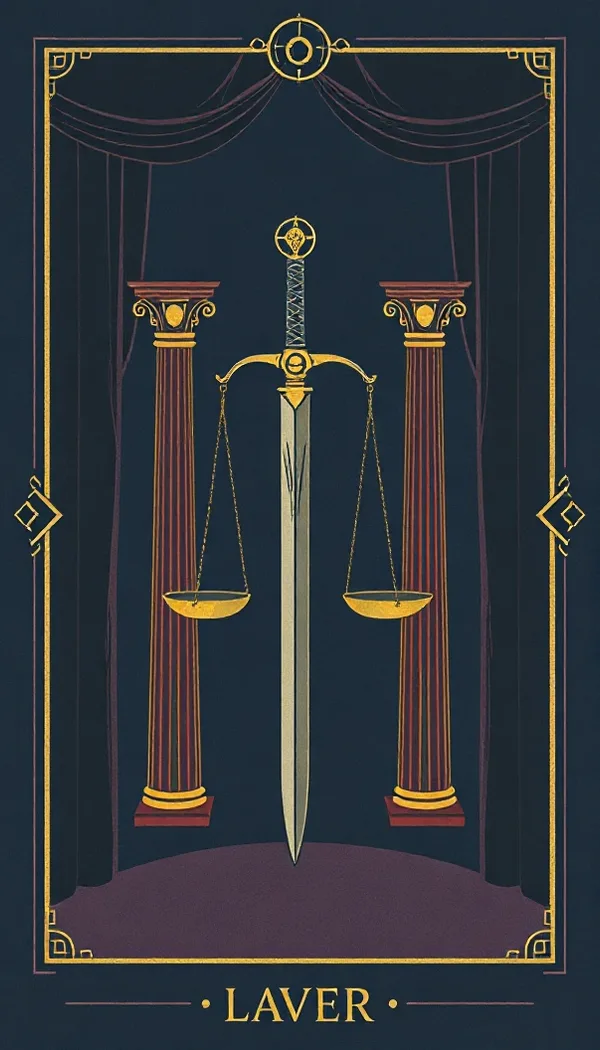
Major Arcana · XI
Justice Tarot Card Meaning
Consequences, fairness, and an honest accounting.
Justice is about cause and effect. It strips away sentiment to look at reality: what actions were taken, what outcomes followed, and what must be acknowledged to move forward. Rather than moral judgement from above, this card represents the cold, clear balance sheet of your own choices and the terms of your current situation.
- Element
- Air
- Association
- Libra
- Upright
- cause and effect, fairness, an honest reckoning
- Reversed
- an imbalance nobody is naming, avoiding responsibility, a one-sided arrangement
Justice meaning at a glance
| Upright keywords | cause and effect, fairness, an honest reckoning, accountability |
|---|---|
| Reversed keywords | an imbalance nobody is naming, avoiding responsibility, a one-sided arrangement, bias |
| Love | who is giving more, accountability for what happened, fairness in the arrangement |
| Career | contracts and terms, being fairly recognised or not, a decision with real consequences |
| Yes or no | Unclear |
| Arcana | Major Arcana · Air · Libra |
Justice upright meaning
Drawing this card signals a moment where reality catches up with past choices. It describes situations where facts, agreements, and accountability take centre stage over personal preference or wishful thinking. You might be negotiating a contract, settling a dispute, or simply reaching a point where you must face the clear outcomes of recent decisions. Justice asks for absolute clarity and willingness to accept your part in the current state of affairs. When this card appears, equity matters more than comfort, and long-term resolution depends entirely on whether everyone involved is willing to look at the situation without bias or self-deception.
Justice reversed meaning
When reversed, the focus shifts inward toward unacknowledged imbalances, delayed decisions, or a refusal to take responsibility. It does not mean you are condemned to an unfair trial, nor does it predict an unavoidable defeat. Instead, it highlights places where the scales are tipping without anyone speaking up. You might be ignoring your own biases, tolerating a one-sided arrangement out of habit, or postponing a difficult choice because the fair option feels uncomfortable. The reversed card asks you to pause and examine where you are avoiding accountability or allowing an unfair situation to linger quietly beneath the surface.
Go deeper: how to read reversed tarot cards
Justice symbolism: what the card shows
In the traditional Rider–Waite–Smith image, a seated figure dressed in a red robe and green mantle sits between two tall stone pillars. The red signifies vital action, while the green mantle suggests growth grounded in discipline. In her right hand, she holds a double-edged sword upright, representing clear-headed discernment that cuts through rationalisations and applies equally to all sides. Her left hand balances golden scales at equal height, pointing to impartial evaluation and the careful weighing of facts. A square jewel on her crown and a square shoe peeking from her hem emphasize grounded, structured reality. Behind her, a purple backdrop separates conscious judgment from unseen influences.
Justice in love and relationships
In relationship contexts, this card turns attention toward fairness, reciprocity, and shared accountability. It asks whether both partners are contributing equally to the relationship's emotional and practical labour. Tarot cannot reveal another person's private thoughts or feelings, but it can highlight the observable dynamic between you. Are issues addressed openly, or are resentments building because one person consistently compromises more than the other? Justice calls for an honest evaluation of how you treat each other and how past actions have led to the current state of the relationship. Restoring balance requires clear communication, taking ownership of mistakes, and committing to terms that respect both individuals equally.
Go deeper: love tarot reading
Justice reversed in love
When this card appears inverted, a dynamic of unaddressed friction or quiet scorekeeping often takes hold. One or both partners may feel an imbalance in effort, affection, or practical responsibilities, yet avoid speaking directly to keep the peace. Rather than resolving issues, grievances are swallowed, leading to subtle resentment or passive resistance. The reversal highlights a tendency to rationalize unfair habits or wait for the other person to fix things first. Restoring equilibrium requires breaking this pattern of silence and bringing suppressed complaints into constructive, honest conversation.
Go deeper: relationship tarot reading
Justice as feelings
When drawing this card regarding someone’s feelings, it is important to remember that tarot cannot read another person's private interior mind. What Justice highlights instead is an emotional stance defined by assessment, detachment, or a clear desire for fairness. The dynamic in question is currently being evaluated on a rational level rather than an overly emotional one. This points to a phase of weighing pros and cons, seeking mutual respect, or waiting to see if past commitments are honoured before taking the next step.
Go deeper: how does he feel about me tarot
Justice as a person — and how someone sees you
Reading this position reflects an external impression or functional role rather than a person's inner psychological state, as tarot cannot report private thoughts. Someone embodying this posture presents as objective, measured, and focused on facts. They tend to communicate directly, expect commitments to be honoured, and evaluate situations based on evidence rather than emotional appeals. In interactions, this person may come across as rigorous or somewhat detached, prioritizing truth and systemic equity above social comfort. They act as an anchor for clarity, cutting through confusion with a cool, even-handed approach.
Go deeper: tarot court cards as people
Justice in career and work
At work, this card points to formal arrangements, evaluations, and decisions that carry significant weight. It often corresponds to contract negotiations, performance reviews, or moments when your work is being assessed against objective standards. The focus here is on whether you are being treated fairly and whether you are delivering what you promised. It demands rigorous professional integrity. If you are handling a dispute or finalizing terms, rely strictly on written agreements, clear evidence, and documented facts rather than verbal assurances or emotional appeals.
Go deeper: career tarot reading
Justice reversed in career
In a work context, the upside-down card points to internalised frustration over workplace dynamics or administrative delays. You might be putting up with an uneven workload, vague contract terms, or biased decision-making without pushing for clarification. Alternatively, it can indicate a personal hesitation to confront a mistake or negotiate fair compensation. Rather than signalling catastrophic failure, it calls for a deliberate pause to review paperwork, verify commitments, and address discrepancies directly before small inequities grow into chronic issues.
Justice in money readings
This card brings your attention to the balance sheet, debts, and formal financial agreements. It is not a prediction of incoming wealth or financial ruin, but a directive to look closely at the numbers. Ensure that contracts are balanced, taxes are accounted for, and obligations are met. If you are involved in a settlement or shared financial arrangement, Justice asks for strict equity and transparency. Take an inventory of what you owe and what is owed to you without rationalising away discrepancies.
Go deeper: money tarot reading
Justice as a decision or advice card
When facing a crossroads, Justice asks you to choose the equitable path over the convenient one. Strip away emotional bias and evaluate the options based on verifiable facts and long-term consequences. Every choice carries a cost, and this card asks whether you are truly prepared to pay the price of the option you prefer. Decide based on what aligns with your principles and fair dealing, even if taking that stance requires an uncomfortable conversation or sacrificing a short-term advantage. Take an honest inventory of your current situation and own your contribution to it. Speak truthfully, honour your agreements, and insist on fair treatment from others. If a situation feels unbalanced, address the facts directly rather than hoping it self-corrects. Align your daily actions with your stated values, even when doing so is uncomfortable. Fairness begins with how honestly you treat yourself.
Go deeper: decision tarot reading
Justice as an outcome
Positioned as a potential outcome, this card indicates a trajectory where facts become impossible to ignore. If the current trajectory continues, lingering ambiguities will likely give way to a clear, definitive accounting. Outcomes under this pattern tend to reflect precisely what was invested—agreements are enforced, efforts are measured, and lingering omissions come to light. It suggests an eventual return to balance, where clear boundaries and realistic assessments replace wishful thinking or unresolved claims.
Is Justice a yes or no card?
Justice yields an unclear result in a binary format because life choices rarely boil down to a simple yes or no without conditions. The outcome depends entirely on the fairness of your actions and how thoroughly you account for the facts. Furthermore, drawing a single card is a weak instrument for a definitive answer; it highlights the principle of accountability rather than granting a pass or fail.
Go deeper: yes or no tarot
Justice combinations
A card changes when it lands next to another. These are the pairings most worth knowing — for the method behind reading any pair, see tarot card combinations.
Justice and The Fool
Pairing raw spontaneity with rigorous accounting creates a tension between impulse and consequence. While the Fool urges taking a leap without looking, Justice demands a full review of potential impacts. Together, they suggest balancing open-ended exploration with realistic boundaries and accountability for your choices.
Justice and Two of Swords
This combination points to a stalled decision where reaching a fair conclusion is blocked by self-protection or incomplete information. Two of Swords highlights deliberate avoidance, while Justice insists that ignoring facts will not prevent their eventual impact. Progress requires taking off the blindfold and confronting truth directly.
Justice and Three of Pentacles
Together, these cards emphasize formal collaboration, clear contractual terms, and fair evaluation of expertise. While Three of Pentacles focuses on teamwork and practical execution, Justice ensures that duties, compensation, and credit are divided equitably, giving the joint project a transparent, firm foundation.
Reflection questions for Justice
A card meaning is only half of a reading. These are the questions this card is really asking, and they work whether or not you agree with the interpretation above.
- If you described this arrangement to a stranger, would it sound fair?
- What is your share of how this got here?
- What consequence are you hoping to avoid rather than address?
Drew Justice in your own reading? A card meaning page describes the card in general. What changes everything is reading it against a specific question — the same card points somewhere quite different depending on what you asked.
Ask your question and see how Justice — or any of the other 77 cards — reads in your situation.
What do you need clarity about?
Ask one question. Draw one card. Get a personalized tarot reading instantly.
Free. No signup. No email.
What is your question about?
This changes how the card is read, not which card you get.
Is this about…
Optional — it takes one tap and sharpens the reading.
How would you like your card?
Both options draw from the full 78-card deck. Nothing about the reading changes.
Choose your card
Take your time. Any one of them.
Your card
Your reading
What this card highlights
What to pay attention to
Your card was drawn first. The reading was then written from your question, the card you actually drew, and the relationship between them.
One card answered the surface question.
But your situation has more layers.
Reading what you wrote, your question appears to contain more than one thing at once:
- What’s really driving this situation
- What you may be overlooking
- The pattern that keeps repeating
- Where this is heading if nothing changes
- What could change the direction
- What is actually within your control
- What you should do next
- Your 3 most important questions, read together
The Unfiltered Reading™
Ask the three questions you can’t stop thinking about and receive one deep reading connecting the cards, patterns and choices across all three.
$9 one time · no subscription
Get My Unfiltered Reading3 questions · 10–12 cards · one connected reading · PDF + optional audio
Reading your card against your question…