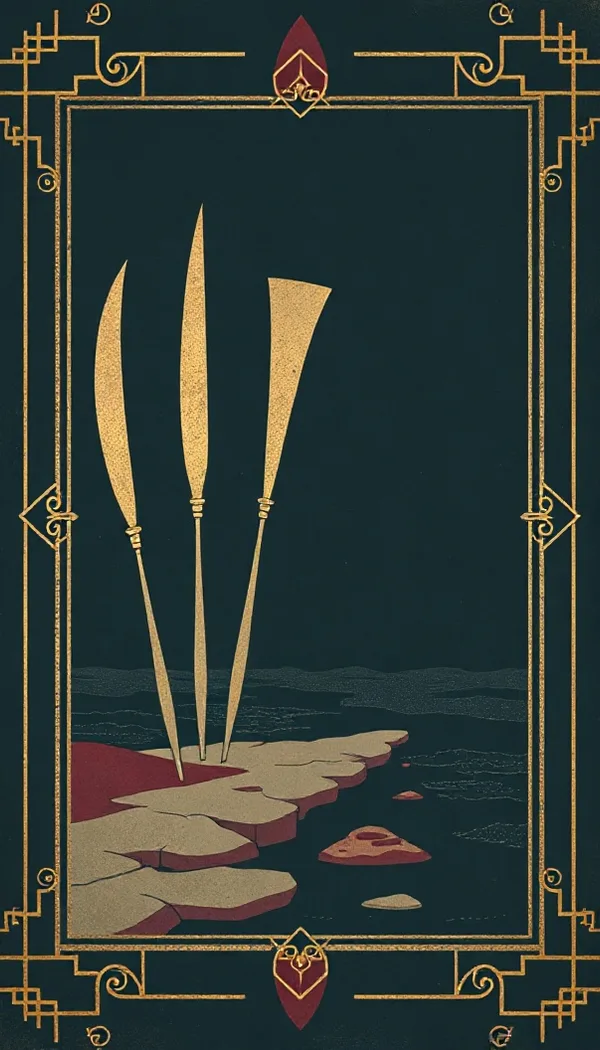
Minor Arcana · Swords · 5 of Swords
Five of Swords Tarot Card Meaning
A win that costs more than it returns.
The Five of Swords shows the moments after a disagreement where someone has walked away with the prize, but the room is left empty and tense. It represents a situation where pushing to win an argument or secure a point ends up damaging the underlying relationship. The focus here is on the hidden costs of taking a firm stance.
- Element
- Air
- Upright
- a hollow victory, winning at a cost, conflict with damage
- Reversed
- stepping away from a fight, making amends, refusing to win at that price
Five of Swords meaning at a glance
| Also written | 5 of Swords |
|---|---|
| Upright keywords | a hollow victory, winning at a cost, conflict with damage, being right and losing anyway |
| Reversed keywords | stepping away from a fight, making amends, refusing to win at that price, reconciliation |
| Love | an argument that damaged more than it settled, needing to be right, a wound left by conflict |
| Career | a workplace conflict with fallout, winning an argument and losing standing, a costly clash |
| Yes or no | Leans no |
| Arcana | Swords · Air |
Five of Swords upright meaning
You might have gained the upper hand, but the fallout renders the prize sour. This position typically reflects an environment marked by lingering resentment, bad faith, or hollow victories. Someone has insisted on getting their way or proving a point at the direct expense of trust and goodwill. It points to a tense atmosphere where words were used as weapons rather than tools for understanding. The focus is not on whether your position was logically correct, but on what was dismantled in order to establish it. You are left holding the field, but the surrounding landscape has suffered clear damage.
Five of Swords reversed meaning
Turning this card upside down shifts the focus from active conflict toward its lingering aftermath or a deliberate choice to step away. It does not mean permanent ruined relationships or unavoidable malice, so there is no reason to dread seeing it. Instead, it indicates a stage where the desire to be right is fading, making space for reflection, repair, or walking away from an unproductive dispute. The energy turns inward as you weigh whether continuing a fight serves any real purpose. You may be ready to drop your guard, admit fault, or simply stop engaging in a battle that drains your energy.
Go deeper: how to read reversed tarot cards
Five of Swords symbolism: what the card shows
In the traditional Rider–Waite–Smith image, a smirking figure stands in the foreground, clutching three swords while two others rest on the ground beside him. In the distance, two defeated figures walk away, one with head bowed, moving toward a body of water. The grey sky above is filled with jagged, wind-blown clouds, creating an unsettled atmospheric backdrop. The gatherer's satisfied expression represents short-sighted triumph, while the discarded weapons emphasize the collateral damage of the skirmish. The retreating figures illustrate the emotional distance and alienation created by sharp exchanges. The choppy clouds signal lingering atmospheric tension rather than clear skies, suggesting that while the immediate contest has concluded, the environment remains volatile.
Five of Swords in love and relationships
In relationship spreads, this card highlights an exchange where scoring points has replaced genuine connection. Arguments may end with a clear winner, but both people leave feeling bruised, defensive, and isolated. This card describes the interpersonal dynamic you are currently navigating, not the unexpressed private thoughts or hidden motives of your partner. It shows a pattern where proving a point matters more than protecting the bond. Continuing down this path risks eroding mutual respect until nothing substantial remains to salvage. To change the trajectory, the focus needs to shift from winning the argument to examining why the argument felt necessary in the first place, prioritising peace over being right.
Go deeper: love tarot reading
Five of Swords reversed in love
When inverted in a romantic context, this placement highlights an exhaustion with ongoing disputes and a desire to dismantle defensive habits. Instead of escalating the next disagreement, there is a distinct impulse to drop old grievances or refuse the bait. It marks a cooling-off phase where both partners may realize that keeping score actively destroys intimacy. The focus shifts toward silent reassessment, releasing the urge to have the final word, and opening space for quiet repair. It signifies a willingness to lay down metaphorical arms, even if rebuilding trust requires deliberate effort.
Go deeper: relationship tarot reading
Five of Swords as feelings
Drawing this card when asking how someone feels requires a realistic boundary: tarot cannot read another person's private interior thoughts or hidden emotions. What it can show is the emotional posture governing the dynamic between you. The atmosphere is currently defined by defensiveness, pride, or a perceived conflict of interest. One or both of you feels the need to protect your stance or secure an advantage rather than show vulnerability. The focus is squarely on self-preservation and staying right, which keeps genuine closeness at bay until someone decides to put down their guard.
Go deeper: how does he feel about me tarot
Five of Swords as a person — and how someone sees you
Tarot cards reflect behavioral patterns and public impressions, never another individual's private thoughts or internal motivations. As a persona or personal style, this card suggests someone who approaches interactions competitively, prioritizing debate tactics over collaboration. They may come across as sharp, defensive, or bent on establishing dominance in conversations. Alternatively, it describes how others perceive your current boundary style: perhaps direct to a fault, uncompromising, or willing to burn bridges to maintain an advantage. Recognizing this posture allows you to evaluate whether an unyielding communication style is actually serving your long-term goals or isolating you.
Go deeper: tarot court cards as people
Five of Swords in career and work
Workplace situations marked by this energy involve professional clashes that leave behind collateral damage. You might succeed in securing a decision, overruling a colleague, or prevailing in a workplace debate, but the cost to your working relationships could prove heavy. Office politics, subtle sabotage, or diminished team morale often follow this pattern. Winning a point is counterproductive if it destroys the trust required to run projects smoothly. Look closely at whether pushing a specific agenda is worth the loss of standing among peers, and consider whether a compromise yields better long-term stability.
Go deeper: career tarot reading
Five of Swords reversed in career
Reversed in a professional context, this card indicates a withdrawal from workplace politics, competitive power struggles, or toxic rivalries. Rather than pushing forward with an escalating dispute or trying to prove a point to management, there is a pivot toward minimizing damage and protecting personal energy. It often marks the moment you decide a professional battle is simply not worth winning, choosing instead to focus on your core work, settle quietly, or seek a cleaner team environment.
Five of Swords in money readings
Financial disputes, contract disagreements, or contested expenses are central when this drawing appears. You might succeed in recovering funds or enforcing a financial right, but legal stress, professional friction, or personal fallout could outweigh the monetary gain. This is not a prediction of financial ruin or a specific settlement figure. Rather, it asks you to assess whether fighting for every last penny costs more in stress and goodwill than the actual sum is worth.
Go deeper: money tarot reading
Five of Swords as a decision or advice card
When weighing a choice, this card urges you to examine what you will lose by insisting on victory. One option might allow you to prove a point, assert dominance, or secure an immediate gain, yet leave you isolated or exhausted. The alternative might involve accepting a partial concession to preserve peace and preserve your energy. Ask yourself if being right is actually worth the disruption it causes, or if walking away delivers the better long-term outcome. Take a step back and calculate the true cost of prevailing in this situation. If an ongoing conflict is draining your energy or destroying valuable connections, consider dropping the argument entirely. Choosing peace over vindication is not weakness; it is a pragmatic assessment of your priorities. Notice where pride is driving your actions, and decide whether holding your ground is serving your overall well-being.
Go deeper: decision tarot reading
Five of Swords as an outcome
Occupying the outcome position, this card indicates a trajectory where pursuing victory at all costs threatens to leave you isolated. If the current pattern of defensive posturing or aggressive debate continues unchanged, the probable result is a pyrrhic triumph: gaining your stated goal while alienating key allies or partners. It warns that continuing to prioritize short-term dominance will likely erode the structural stability of the situation, leaving you with control over a broken foundation.
Is Five of Swords a yes or no card?
This card leans no. Its presence highlights tension, collateral damage, and hollow victories, suggesting that forcing a positive answer right now comes at too high a personal or relational price. Keep in mind that pulling a single card is a very limited instrument for complex yes-or-no questions, as it highlights the underlying atmosphere rather than offering a concrete guarantee.
Go deeper: yes or no tarot
Five of Swords combinations
A card changes when it lands next to another. These are the pairings most worth knowing — for the method behind reading any pair, see tarot card combinations.
Five of Swords and Two of Cups
Pairing conflict with partnership shows a tension between wanting connection and demanding to be right. It points to a situation where defensive arguments are actively eroding mutual trust, suggesting that peace will require setting aside ego in favor of shared harmony.
Five of Swords and Three of Swords
This alignment amplifies the risk of harsh words causing deep emotional fallout. The combination highlights an environment where sharp disagreements leave lasting wounds, indicating that immediate restraint is necessary to prevent an argument from doing permanent damage to key relationships.
Five of Swords and Ten of Wands
Combining hollow victory with heavy burdens suggests that winning a current struggle will only increase your responsibilities without delivering real satisfaction. The pair points to the physical and mental fatigue that comes from fighting battles you never actually needed to wage.
Reflection questions for Five of Swords
A card meaning is only half of a reading. These are the questions this card is really asking, and they work whether or not you agree with the interpretation above.
- If you win this argument, what will you have actually gained?
- What has already been damaged by how this has gone?
- What would walking away from this conflict cost you, and what would it save?
Drew Five of Swords in your own reading? A card meaning page describes the card in general. What changes everything is reading it against a specific question — the same card points somewhere quite different depending on what you asked.
Ask your question and see how Five of Swords — or any of the other 77 cards — reads in your situation.
What do you need clarity about?
Ask one question. Draw one card. Get a personalized tarot reading instantly.
Free. No signup. No email.
What is your question about?
This changes how the card is read, not which card you get.
Is this about…
Optional — it takes one tap and sharpens the reading.
How would you like your card?
Both options draw from the full 78-card deck. Nothing about the reading changes.
Choose your card
Take your time. Any one of them.
Your card
Your reading
What this card highlights
What to pay attention to
Your card was drawn first. The reading was then written from your question, the card you actually drew, and the relationship between them.
One card answered the surface question.
But your situation has more layers.
Reading what you wrote, your question appears to contain more than one thing at once:
- What’s really driving this situation
- What you may be overlooking
- The pattern that keeps repeating
- Where this is heading if nothing changes
- What could change the direction
- What is actually within your control
- What you should do next
- Your 3 most important questions, read together
The Unfiltered Reading™
Ask the three questions you can’t stop thinking about and receive one deep reading connecting the cards, patterns and choices across all three.
$9 one time · no subscription
Get My Unfiltered Reading3 questions · 10–12 cards · one connected reading · PDF + optional audio
Reading your card against your question…